Ciprofloxacin and Running: Navigating Tendon Risks and Recovery Protocols
For dedicated runners—whether amateur marathoners, weekend joggers, or elite track athletes—the physical integrity of the lower extremities is paramount. Running is a high-impact, repetitive sport that places extraordinary demands on the musculoskeletal system, particularly the Achilles tendon, the plantar fascia, and the patellar tendon. When an active runner is prescribed Ciprofloxacin (Cipro), a potent fluoroquinolone antibiotic, they face a precarious intersection between necessary medical treatment and the risk of catastrophic, career-altering structural injury.
Editorial safety update: Ciprofloxacin and Running: Navigating Tendon Risks and Recovery Protocols
Last reviewed: June 20, 2026. This page was updated to make the patient-safety purpose clearer, add practical monitoring steps, and point readers to authoritative ciprofloxacin safety information. It is written for people preparing for a conversation with a prescriber or pharmacist, not for self-diagnosis or medication changes.
How to use this article: focus on the timing of symptoms, whether the infection itself is improving, and which details would help a clinician decide whether ciprofloxacin is still the right choice. For ciprofloxacin and running: navigating tendon risks and recovery protocols, the main practical theme is tendon, muscle, and joint safety.
Key points to take from this page
- Pause strenuous activity and contact a clinician promptly if new tendon pain, swelling, warmth, stiffness, or sudden weakness appears.
- Mention corticosteroid use, age over 60, kidney disease, transplant history, or a prior tendon problem because these can change the risk discussion.
- Track where the pain started, which dose day it appeared on, and whether walking, gripping, lifting, or stairs make it worse.
Questions worth asking a clinician or pharmacist
- Does this symptom fit a tendon warning that needs an exam or imaging?
- Should activity be restricted until a clinician reviews the symptom pattern?
- Is there a non-fluoroquinolone option for this infection if risk factors are present?
Related safety reading on this site
- Cipro and Steroids: Tendon Risk
- Emergency Warning Signs With Cipro Side Effects
- Questions to Ask Your Pharmacist About Cipro Side Effects
Authoritative sources used for this update
- FDA prescribing information for CIPRO tablets and oral suspension
- MedlinePlus ciprofloxacin drug information
- FDA MedWatch adverse event reporting program
Medical note: seek urgent care for severe allergic symptoms, trouble breathing, sudden severe chest/back/abdominal pain, fainting, seizures, severe confusion, serious blood-sugar symptoms, severe or bloody diarrhea, or sudden tendon pain with loss of function. For less dramatic but new symptoms, contact the prescribing clinician promptly.
The U.S. Food and Drug Administration (FDA) has issued stark black box warnings regarding the risk of severe tendinitis and tendon rupture associated with fluoroquinolone use. For the general population, this risk is concerning; for runners, whose tendons regularly absorb forces equal to several times their body weight, the risk is exponentially magnified. This comprehensive guide explores the specific dangers Cipro poses to runners, the biochemical mechanisms behind tendon degradation, and evidence-based protocols for safe recovery and return to play.
The Biomechanics of Running and Fluoroquinolone Vulnerability
To fully grasp why running on Cipro is so hazardous, one must understand both the biomechanical forces involved in the running gait cycle and the biochemical impact of the antibiotic on connective tissue.
During the stance phase of running—when the foot strikes the ground and bears the body’s weight—the Achilles tendon acts as a powerful, elastic spring. It absorbs kinetic energy as the ankle dorsiflexes and forcefully recoils to propel the body forward during toe-off. Research in the Journal of Applied Biomechanics indicates that the Achilles tendon routinely endures loads exceeding 6 to 8 times a runner’s body weight during this cycle.
Tendons rely heavily on Type I collagen to withstand these immense tensile forces. However, fluoroquinolones like Ciprofloxacin aggressively undermine this structural foundation. Clinical studies have shown that Cipro upregulates matrix metalloproteinases (MMPs)—enzymes that actively digest collagen fibers. Simultaneously, the drug exhibits direct cytotoxicity to tenocytes, the specialized cells responsible for producing new collagen and repairing microscopic wear-and-tear.
Consequently, a runner taking Cipro is essentially asking a biochemically weakened, rapidly degrading “spring” to endure extreme, repetitive loading. The result is often severe tendinopathy or an acute structural failure—a complete tendon rupture.
High-Risk Areas for Runners on Ciprofloxacin
While fluoroquinolone toxicity can affect any connective tissue in the body, the repetitive impact of running concentrates the stress—and the subsequent damage—on specific anatomical structures.
The Achilles Tendon
The Achilles tendon is, without question, the most vulnerable site for runners exposed to Ciprofloxacin. It is the thickest and strongest tendon in the human body, but it is paradoxically the most frequently ruptured tendon associated with fluoroquinolone use. A study in the British Journal of Sports Medicine highlights that Achilles tendon injuries account for over 90% of all reported fluoroquinolone-associated tendinopathies. For runners, early symptoms often present as a deep, aching pain or stiffness in the lower calf or the back of the heel, particularly evident during the first few steps in the morning or at the onset of a run.
The Patellar Tendon and Knee Joint
The patellar tendon, connecting the kneecap to the shinbone, absorbs massive eccentric forces during downhill running and deceleration. Cipro-induced weakness here can manifest as “runner’s knee” (patellofemoral pain syndrome) or acute patellar tendinitis. Runners may experience sharp pain just below the kneecap, especially when navigating descents or climbing stairs.
The Plantar Fascia
While technically a ligamentous aponeurosis rather than a tendon, the plantar fascia—the thick band of tissue running along the bottom of the foot—is heavily reliant on collagen integrity. Fluoroquinolone toxicity can severely exacerbate or trigger acute plantar fasciitis in runners, presenting as piercing heel pain that worsens with weight-bearing activities.
Immediate Actions: What to Do if Prescribed Cipro
If you are a runner and a physician prescribes Ciprofloxacin, proactive communication and immediate lifestyle modifications are essential to safeguard your long-term athletic health.
1. Discuss Alternatives with Your Doctor
The most effective strategy is avoidance. Immediately inform your prescribing physician about your running regimen and ask if an alternative, non-fluoroquinolone antibiotic (such as a Macrolide, Cephalosporin, or Tetracycline) would be equally effective for your specific infection. The FDA advises that fluoroquinolones should be reserved for conditions where no alternative treatment options exist.
2. Cease All High-Impact Activity
If Cipro is the only viable medical option, you must immediately suspend all running, jumping, and plyometric exercises. Continuing to run while taking this medication is a gamble with devastating odds. Substitute high-impact training with low-impact cardiovascular alternatives, provided they do not cause pain.
3. Safe Alternative Cross-Training
To maintain aerobic fitness without risking tendon rupture, consider the following low-impact alternatives during your treatment course:
- Swimming or Deep-Water Running: These activities provide excellent cardiovascular benefits while entirely removing weight-bearing stress from the lower extremities.
- Stationary Cycling: While safer than running, cycling still requires tendon engagement. Use light resistance and maintain a moderate cadence. Stop immediately if you experience Achilles or knee pain.
- Upper Body Ergometer: Utilizing an arm bike is an excellent way to elevate the heart rate while completely resting the lower body tendons.
The Return-to-Running Protocol: A Conservative Approach
The most perilous period for a runner often occurs immediately after the antibiotic course is finished. It is a critical misconception that the risk of tendon rupture vanishes the day the medication is stopped. The FDA warns that tendinopathy and ruptures can occur several months after completing a fluoroquinolone regimen.
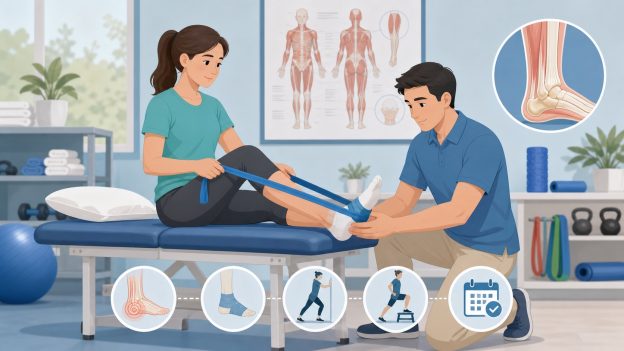
Returning to running must follow a highly conservative, strictly phased protocol, ideally overseen by a sports medicine physician or physical therapist.
Phase 1: The Asymptomatic Waiting Period (Weeks 1-4 Post-Cipro)
Following the final dose, maintain strict avoidance of high-impact activities for a minimum of 2 to 4 weeks. This period allows the body to clear the drug and begin stabilizing collagen production. Focus on gentle, pain-free mobility work and light stretching. Do not attempt to run.
Phase 2: Gradual Loading and Strength Assessment (Weeks 5-8)
Before resuming running, the tendons must demonstrate the capacity to handle load without pain. Begin introducing isometric exercises (e.g., holding a calf raise position) and slow, controlled eccentric movements. If any pain, swelling, or stiffness occurs, regress to Phase 1.
Phase 3: The Walk/Run Progression (Weeks 9-12+)
Once strength exercises are pain-free, begin a structured walk/run program on a flat, forgiving surface (like a rubberized track or treadmill). Start with highly conservative intervals, such as jogging for 1 minute followed by walking for 4 minutes. Gradually increase the running intervals over several weeks, carefully monitoring for delayed-onset pain the morning after a session.
Phase 4: Resuming Normal Training Volume
Only after successfully completing the walk/run progression without symptoms should a runner begin to rebuild weekly mileage. Reintroduce speed work, hill climbs, and long runs one at a time, allowing ample recovery between challenging sessions. Be prepared to immediately halt training if old aches resurface.
Frequently Asked Questions (FAQs)
I feel completely fine while taking Cipro. Can I continue my marathon training?
Absolutely not. The biochemical degradation of collagen occurs at a cellular level long before structural pain becomes evident. Continuing to subject your tendons to the extreme loads of marathon training while on Cipro significantly increases the risk of a sudden, catastrophic rupture without any prior warning signs. The temporary loss of fitness is vastly preferable to a surgical repair and a year-long rehabilitation.
Can I take NSAIDs like Ibuprofen to manage tendon soreness after running on Cipro?
Using Non-Steroidal Anti-Inflammatory Drugs (NSAIDs) while on fluoroquinolones is highly controversial and generally discouraged. Some studies suggest that concurrent use can exacerbate the central nervous system side effects of the antibiotic. More importantly, masking tendon pain with analgesics removes your body’s early warning system, increasing the likelihood that you will push a damaged tendon to the point of rupture. Consult your doctor for safe pain management strategies.
Are there any supplements that can protect my tendons from Cipro?
While robust, large-scale clinical trials are lacking, some sports medicine professionals suggest that supporting general tendon health may be beneficial. Adequate hydration is crucial. Some preliminary research points to the potential benefits of Magnesium supplementation (as fluoroquinolones are known to deplete intracellular magnesium) and Vitamin C (essential for collagen synthesis). Always discuss new supplements with your healthcare provider to ensure they do not interact with the antibiotic.
If my Achilles ruptures, will I ever be able to run again?
A complete Achilles tendon rupture is a severe injury requiring surgical repair or prolonged immobilization. While the road to recovery is long—often spanning 9 to 12 months—many runners do successfully return to their sport. However, the rehabilitated tendon may never regain its pre-injury elasticity, and runners often have to permanently adjust their gait, training volume, and footwear. Prevention is undeniably the best strategy.
References
- U.S. Food and Drug Administration (FDA). (2016). FDA Drug Safety Communication: FDA updates warnings for oral and injectable fluoroquinolone antibiotics due to disabling side effects.
- Lui, P. P., Maffulli, N., Rolf, C., & Smith, R. K. (2011). What are the validated animal models for tendinopathy?. Scandinavian Journal of Medicine & Science in Sports, 21(1), 3-17.
- Corps, A. N., Curry, V. A., Harrall, R. L., Dutt, D., Hazleman, B. L., & Riley, G. P. (2002). Ciprofloxacin reduces the stimulation of prostaglandin E(2) output by interleukin-1beta in human tendon-derived cells. Rheumatology, 41(12), 1371-1376.
- American Orthopaedic Society for Sports Medicine (AOSSM). (2022). Achilles Tendon Injuries in Athletes: Mechanisms and Prevention.
- Halimi, M., & Zargar, B. (2019). Fluoroquinolone-induced tendinopathy: A comprehensive review of the literature. Journal of Clinical Pharmacy and Therapeutics, 44(5), 653-659.
Medical Disclaimer: This article is for educational purposes only and is not a substitute for professional medical advice, diagnosis, or treatment. Always consult a qualified healthcare provider before making any decisions about medications. If you experience severe symptoms, seek emergency medical care immediately.