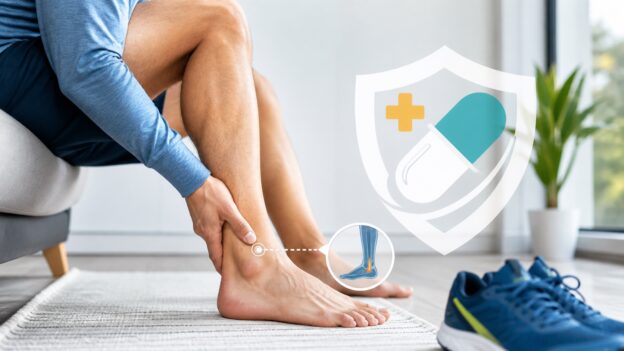
The Achilles Tendon: The Primary Target of Ciprofloxacin Toxicity
Ciprofloxacin, universally recognized by its brand name Cipro, remains one of the most frequently prescribed fluoroquinolone antibiotics globally. Its broad-spectrum capabilities make it a highly effective agent against stubborn bacterial infections, particularly those involving the urinary tract, prostate, and gastrointestinal systems. However, this potent antimicrobial action is tethered to a severe and unique adverse effect profile. The United States Food and Drug Administration (FDA) mandates rigorous black box warnings detailing the high probability of fluoroquinolone-induced tendinopathy and catastrophic tendon rupture.
Editorial safety update: Cipro Side Effects: Identifying Achilles Tightness and Preventing Catastrophic Rupture
Last reviewed: June 20, 2026. This page was updated to make the patient-safety purpose clearer, add practical monitoring steps, and point readers to authoritative ciprofloxacin safety information. It is written for people preparing for a conversation with a prescriber or pharmacist, not for self-diagnosis or medication changes.
How to use this article: focus on the timing of symptoms, whether the infection itself is improving, and which details would help a clinician decide whether ciprofloxacin is still the right choice. For cipro side effects: identifying achilles tightness and preventing catastrophic rupture, the main practical theme is tendon, muscle, and joint safety.
Key points to take from this page
- Pause strenuous activity and contact a clinician promptly if new tendon pain, swelling, warmth, stiffness, or sudden weakness appears.
- Mention corticosteroid use, age over 60, kidney disease, transplant history, or a prior tendon problem because these can change the risk discussion.
- Track where the pain started, which dose day it appeared on, and whether walking, gripping, lifting, or stairs make it worse.
Questions worth asking a clinician or pharmacist
- Does this symptom fit a tendon warning that needs an exam or imaging?
- Should activity be restricted until a clinician reviews the symptom pattern?
- Is there a non-fluoroquinolone option for this infection if risk factors are present?
Related safety reading on this site
- Cipro and Steroids: Tendon Risk
- Emergency Warning Signs With Cipro Side Effects
- Questions to Ask Your Pharmacist About Cipro Side Effects
Authoritative sources used for this update
- FDA prescribing information for CIPRO tablets and oral suspension
- MedlinePlus ciprofloxacin drug information
- FDA MedWatch adverse event reporting program
Medical note: seek urgent care for severe allergic symptoms, trouble breathing, sudden severe chest/back/abdominal pain, fainting, seizures, severe confusion, serious blood-sugar symptoms, severe or bloody diarrhea, or sudden tendon pain with loss of function. For less dramatic but new symptoms, contact the prescribing clinician promptly.
While any tendon in the human body can be affected, statistical and clinical data overwhelmingly pinpoint the Achilles tendon as the primary casualty. Over 90% of all documented fluoroquinolone-related tendon ruptures occur in the Achilles. This phenomenon, known as Fluoroquinolone-Associated Achilles Tendinopathy (FAAT), rarely presents as a sudden, unprovoked snap. Instead, it is almost always preceded by a distinct prodromal symptom: a profound, unnatural sense of “tightness” in the back of the heel and calf. Distinguishing this specific chemical tightness from standard physical soreness—and knowing exactly how to track its progression—is the most critical skill a patient can develop to prevent a permanent, debilitating rupture.
The Pathogenesis: Why the Achilles is Uniquely Vulnerable
To understand why Cipro disproportionately destroys the Achilles tendon, one must examine the intersection of biomechanical stress, vascular anatomy, and the drug’s specific cellular toxicity.
The Achilles is the thickest and most robust tendon in the human body, serving as the vital mechanical link between the powerful calf muscles (gastrocnemius and soleus) and the heel bone (calcaneus). During basic activities like walking, running, or climbing stairs, the Achilles routinely absorbs mechanical loads equivalent to three to ten times a person’s body weight. Despite this immense mechanical burden, the Achilles harbors a critical structural flaw: the “watershed region.”
Located approximately 2 to 6 centimeters proximal to the tendon’s insertion point on the heel, the watershed region is notoriously hypovascular. It receives significantly less blood flow compared to the surrounding muscle tissue. When Ciprofloxacin enters the bloodstream, its toxicity manifests through three primary pathways that devastate this specific region:
- Cellular Arrest and Apoptosis: Fluoroquinolones directly inhibit the proliferation of tenocytes (the specialized cells responsible for maintaining and repairing the tendon matrix). As the drug accumulates, it triggers apoptosis (programmed cell death), leaving the tendon biologically inert and unable to repair everyday micro-trauma.
- Collagen Matrix Degradation: Cipro upregulates the expression of specific matrix metalloproteinases (MMPs), enzymes that actively digest Type I collagen. The tendon’s structural scaffolding is literally chemically dissolved from the inside out.
- Ischemic Entrapment: Because the watershed region has poor blood flow, the toxic accumulation of Ciprofloxacin is cleared incredibly slowly. The tendon becomes trapped in a state of chronic cellular toxicity, leading to rapid, localized degeneration exactly where the mechanical forces are greatest.
Decoding the Symptom: Normal Soreness vs. Chemical Tightness
Many patients initially dismiss the early warning signs of Cipro toxicity, confusing it with the normal muscular stiffness that follows a long walk or a strenuous workout. However, the physiological mechanisms are fundamentally different.
Normal muscular soreness (DOMS) is caused by microscopic tears in the muscle fibers that heal stronger through increased blood flow and cellular repair. It typically resolves within 48 to 72 hours. In stark contrast, Cipro-induced Achilles tightness is a symptom of extracellular matrix degradation and acute tenosynovitis (inflammation of the tendon sheath). The tendon itself is losing elasticity. The collagen fibers, normally arranged in smooth, gliding parallel bundles, become disorganized, fibrotic, and rigid. This stiffness is not a sign of the muscle adapting; it is the physical sensation of the tendon structure failing.
The Achilles Tracking Matrix: 4 Stages of Degradation
Because the progression toward rupture can be rapid, patients taking Ciprofloxacin must actively monitor their Achilles tendons daily. Utilizing a structured day-by-day tracking method is essential. If you experience the onset of tightness, evaluate your symptoms against the following four-stage matrix:
Stage 1: The Morning “Start-Up” Stiffness
The earliest indicator of FAAT is pronounced stiffness immediately upon waking. When you take your first few steps out of bed, the Achilles feels incredibly tight, as if the cord has shrunk overnight. In this early stage, the stiffness typically “warms up” and resolves after 10 to 15 minutes of gentle walking. This is the critical moment to intervene and cease high-impact activities.
Stage 2: Persistent Activity-Induced Pain
If the chemical damage progresses, the morning stiffness evolves into a dull, persistent ache that worsens with activity. You may notice a sharp twinge when pushing off your toes while walking, or a burning sensation when navigating stairs. The pain is no longer relieved by “warming up”; rather, continued mechanical stress exacerbates the inflammation. Gently squeezing the tendon 2 to 6 cm above the heel will likely elicit significant tenderness.
Stage 3: Visible Swelling, Nodules, and Gait Alteration
In this advanced stage, the tendon sheath becomes highly inflamed (tenosynovitis). You may observe visible swelling, redness, and the affected Achilles will appear thicker than the healthy side. Furthermore, you may palpate small, hard nodules along the tendon cord—evidence of disorganized scar tissue attempting to bridge areas of severe collagen breakdown. Subconscious gait alterations occur; you will likely begin limping or walking flat-footed to avoid flexing the calf muscle.
Stage 4: The Impending Rupture Zone
This is a medical emergency. The Achilles is constantly throbbing, even at rest. The tightness is so severe that it is physically difficult to bring the foot to a 90-degree angle (dorsiflexion). Any sudden movement—stepping off a curb, quickly changing direction, or lunging forward—carries a massive risk of a complete structural failure, often described by patients as feeling like they were violently kicked or shot in the back of the ankle.
Proven Strategies to Prevent Rupture
If you identify yourself in any of the stages above while taking, or shortly after finishing, a Ciprofloxacin prescription, immediate action is required to prevent a full-thickness rupture.
1. Immediate Medical Consultation and Drug Discontinuation
Do not wait for your next scheduled appointment. Contact your prescribing physician immediately to report the Achilles tightness. They will almost certainly advise you to stop taking Ciprofloxacin and transition you to a different class of antibiotics. Never abruptly stop antibiotics without securing a replacement prescription, as untreated infections are dangerous.
2. Total Elimination of Tensile Stress
Cease all running, jumping, hiking, and prolonged walking. The weakened collagen matrix cannot withstand tensile stress. Activities must be restricted to essential daily movements only. Avoid walking barefoot or wearing zero-drop shoes, as these positions place maximum stretch on the Achilles cord.
3. Utilization of Heel Wedges and Orthotics
To physically relieve tension on the damaged tendon, elevate your heels. Using simple orthotic heel wedges in your shoes, or wearing shoes with a slight heel raise (like a supportive running shoe or a low-heeled boot), slightly shortens the distance between the calf and the heel bone. This mechanical offloading provides immediate symptomatic relief and protects the fragile tissue from overstretching.
4. Avoid Aggressive Stretching and Massage
The most common and catastrophic mistake patients make is attempting to aggressively “stretch out” the tightness. Deep calf stretches or aggressive deep-tissue massage on a Cipro-damaged tendon will force the weakened collagen fibers apart, directly causing micro-tears that rapidly escalate to a full rupture. The tendon must be allowed to rest in a neutral position.
Recognizing the Risk Amplifiers
While any patient can develop FAAT, certain demographic and clinical profiles exponentially increase the risk of severe Achilles damage. Understanding these risk amplifiers is vital for personalized monitoring.
- Concurrent Corticosteroid Therapy: The use of oral steroids (like prednisone) or localized cortisone injections while on Cipro is the single greatest risk factor for tendon rupture. This combination creates a “perfect storm” of tissue destruction.
- Advanced Age (Over 60): As we age, baseline vascularity to the extremities decreases, and cellular turnover slows down. Older adults are significantly less equipped to repair the acute chemical damage inflicted by fluoroquinolones.
- Renal Impairment: Ciprofloxacin is cleared from the body primarily through the kidneys. Patients with impaired renal function experience much higher systemic concentrations of the drug, leading to more profound and prolonged toxicity within the tendon tissues.
Frequently Asked Questions (FAQ)
1. Can I use ice to reduce the Achilles swelling?
Yes, in the acute inflammatory stages (Stage 2 and 3), applying ice wrapped in a thin towel for 15-20 minutes can effectively reduce localized swelling and numb the pain. However, avoid applying heat during the acute phase, as it can increase blood flow and exacerbate the inflammatory response.
2. How long after finishing Cipro am I still at risk for an Achilles rupture?
The FDA explicitly warns that the risk of tendinopathy and rupture remains elevated for several months after the final dose. Clinical case reports have documented Achilles ruptures occurring up to six to eight months post-treatment. The chemical damage to the matrix takes significant time to repair.
3. Should I use a walking boot or crutches if my Achilles feels tight?
If you are experiencing Stage 3 or Stage 4 symptoms (severe pain, swelling, nodules, limping), a medical professional will likely recommend immobilization with a CAM (Controlled Ankle Motion) walking boot or crutches. This is a vital protective measure to prevent sudden, catastrophic loading of the tendon until diagnostic ultrasound can assess the structural integrity.
4. Are there any dietary changes that help the Achilles heal faster?
While definitive clinical trials are limited, supporting the body’s natural collagen synthesis pathways is recommended. Adequate hydration, sufficient high-quality protein intake, Vitamin C (vital for collagen formation), and repairing intracellular magnesium levels (often depleted by Cipro) are foundational steps in the long-term recovery process.
References
- U.S. Food and Drug Administration (FDA). (2016). FDA updates warnings for oral and injectable fluoroquinolone antibiotics due to disabling side effects.
- Khaliq, Y., & Zhanel, G. G. (2003). Fluoroquinolone-associated tendinopathy: a critical review of the literature. Clinical Infectious Diseases, 36(11), 1404-1410.
- Childs, S. G. (2007). Fluoroquinolone toxicity symptoms in a patient presenting with low back pain. Orthopaedic Nursing, 26(5), 312-316.
- American Academy of Orthopaedic Surgeons (AAOS). (2021). Achilles Tendinitis and Rupture Data.
- Kim, G. K. (2010). The Risk of Fluoroquinolone-induced Tendinopathy and Tendon Rupture. The Journal of Clinical and Aesthetic Dermatology, 3(4), 49-54.
Medical Disclaimer: This article is for educational purposes only and is not a substitute for professional medical advice, diagnosis, or treatment. Always consult a qualified healthcare provider before making any decisions about medications. If you experience severe symptoms, seek emergency medical care immediately.